📞  — free, 24/7
— free, 24/7 — free, 24/7| Package | Price per Dose | Price | |
|---|---|---|---|
| 360 pills | £0.63 | £326.84 £228.79 Free shipping | |
| 180 pills | £0.68 | £174.74 £122.32 | |
| 120 pills | £0.93 | £158.56 £110.99 | |
| 90 pills | £1.06 | £137.52 £96.27 | |
| 60 pills | £1.17 | £99.76 £69.83 | |
| 30 pills | £1.89 | £81.05 £56.74 | |
| 360 pills | £0.93 | £477.33 £334.13 Free shipping | |
| 180 pills | £1.05 | £270.21 £189.15 Free shipping | |
| 120 pills | £1.18 | £202.25 £141.57 | |
| 90 pills | £1.29 | £166.65 £116.65 | |
| 60 pills | £1.55 | £132.67 £92.87 | |
| 30 pills | £2.27 | £97.07 £67.95 |
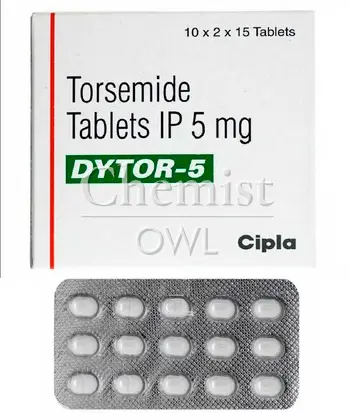
Torasemide was introduced in the late 1980s as a potent loop diuretic with high oral bioavailability and a longer duration of action than furosemide. It inhibits the Na+-K+-2Cl− cotransporter in the ascending limb of the loop of Henle, producing rapid natriuresis and diuresis. The drug is widely prescribed to mobilize excess fluid in heart failure and in edema from liver cirrhosis or renal disease.
Torasemide is a high‑ceiling loop diuretic. It acts on the thick ascending limb of the loop of Henle by blocking the Na+-K+-2Cl− cotransporter, which increases excretion of sodium, chloride, and water.
The agent is well absorbed after oral administration, with substantial bioavailability, and it delivers a relatively predictable diuretic response. Most of the drug is excreted unchanged in the urine, with a smaller portion undergoing hepatic metabolism.
The primary use is to reduce fluid overload in patients with congestive heart failure, hepatic cirrhosis with ascites, and certain nephrotic states. It is also employed to improve symptoms of edema and to lower elevated venous pressure in these settings.
In suitable patients, torasemide provides a reliable and convenient means of diuresis, often allowing once‑daily dosing. Clinicians tailor therapy to the degree of edema, renal function, and blood pressure, balancing efficacy with electrolyte stability.
Dosing is individualized. Initiation typically begins at a low dose, followed by titration based on diuretic response, weight change, and electrolyte measurements.
Timing and administration are important. Take torasemide in the morning when possible to reduce nocturia. It can be taken with or without food; if GI upset occurs, take with meals. If a patient needs multiple daily doses, space them by about 8–12 hours.
Missed doses and storage should be handled as follows: If you miss a dose, take it as soon as you remember unless it is close to the time of the next dose. Do not double up unless advised by a clinician. Store tablets at room temperature, away from moisture and heat, and keep them out of reach of children.
Common effects relate to diuresis and volume depletion: frequent urination, dizziness, lightheadedness, and thirst. These are usually mild and transient but can be bothersome in some patients.
Electrolyte disturbances occur, especially low potassium and sodium, which can cause muscle cramps, weakness, and, in some cases, changes in heart rhythm. Other possible reactions include dehydration, gout flares due to elevated uric acid, photosensitivity, and rare allergic responses.
Seek medical advice for signs of excessive diuresis or dehydration, such as fainting, very rapid weight loss, or persistent dizziness. Also contact a clinician if swelling worsens, urine output falls, or you notice troubling electrolyte symptoms like persistent muscle weakness or confusion.
Consult a clinician if you are pregnant or planning pregnancy, or if you are breast‑feeding. Discuss any new medicines, including over‑the‑counter drugs, as NSAIDs or lithium and other agents can interact with diuretics and require dose adjustments or monitoring.
14–21 days. Free from £151.02 .
5–9 days. £22.65
−10% when paying with cryptocurrency.
−10% on all repeat orders.
All orders are packed in neutral, unbranded boxes with no product name on the outside.