📞  — free, 24/7
 — free, 24/7| Package | Price per Dose | Price | |
|---|---|---|---|
| 360 pills | £0.80 | £286.25 Free shipping | |
| 180 pills | £0.85 | £153.34 Free shipping | |
| 120 pills | £0.92 | £110.18 | |
| 90 pills | £1.00 | £89.73 | |
| 60 pills | £1.11 | £67.01 | |
| 30 pills | £1.36 | £40.88 | |
| 360 pills | £1.31 | £470.28 Free shipping | |
| 180 pills | £1.41 | £253.31 Free shipping | |
| 120 pills | £1.52 | £182.88 Free shipping | |
| 90 pills | £1.64 | £147.66 | |
| 60 pills | £1.79 | £107.91 | |
| 30 pills | £2.24 | £67.01 | |
| 180 pills | £2.00 | £360.09 Free shipping | |
| 120 pills | £2.15 | £257.85 Free shipping | |
| 90 pills | £2.34 | £210.14 Free shipping | |
| 60 pills | £2.61 | £156.75 Free shipping | |
| 30 pills | £3.18 | £95.41 | |
| 20 pills | £3.29 | £65.87 | |
| 10 pills | £3.52 | £35.20 |
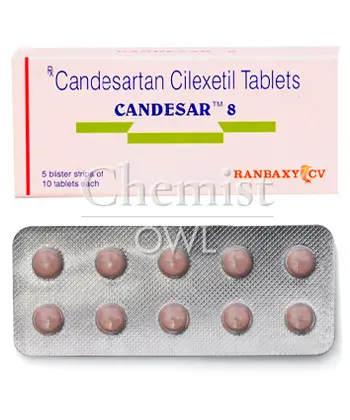
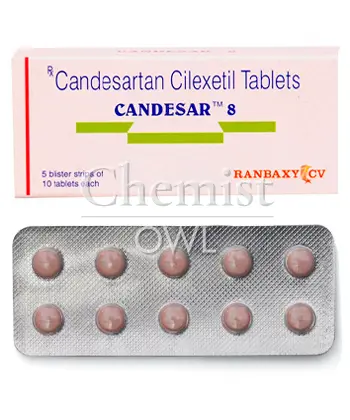
Candesartan is an angiotensin II receptor blocker (ARB) that selectively antagonizes the angiotensin II type 1 (AT1) receptor. By blocking AT1 receptor–mediated vasoconstriction and aldosterone release, candesartan lowers systemic vascular resistance and reduces preload and afterload, supporting improved cardiac output; its primary therapeutic uses are the treatment of essential hypertension and symptomatic heart failure.
Candesartan is supplied as candesartan cilexetil, a prodrug rapidly hydrolyzed to the active metabolite candesartan. After oral administration, peak plasma levels are typically reached within 3–4 hours and the drug is predominantly excreted unchanged by the kidneys, with a minor role for hepatic pathways. The formulation supports once‑daily dosing in most patients, though frequency and dose may be adjusted by clinical response and tolerability.
The pharmacokinetic profile supports steady antihypertensive effect with gradual titration. Candesartan is generally well tolerated in adults; clinicians tailor starting doses to comorbidity, volume status, and concomitant therapies. Initiation often requires monitoring for orthostatic symptoms and early changes in renal function or electrolytes.
Primary indications include essential hypertension in adults to lower blood pressure and reduce cardiovascular risk. It may be prescribed as monotherapy or in combination with diuretics, calcium‑channel blockers, or other antihypertensives to achieve guideline‑directed targets. Blood pressure reduction with candesartan is typically sustained with gradual dose adjustment and regular follow‑up.
In adults with symptomatic heart failure, candesartan is used as part of standard therapy to reduce cardiovascular hospitalizations and to improve functional status. It is commonly added to baseline therapy according to heart failure guidelines, with dose titration guided by hemodynamic tolerance and renal function. Candesartan is also indicated for patients with heart failure who cannot tolerate ACE inhibitors, providing an alternative blockade of the renin–angiotensin–aldosterone system (RAAS).
Candesartan binds selectively to the angiotensin II type 1 receptor (AT1). This receptor blockade prevents angiotensin II from producing vasoconstriction, sodium and water retention, aldosterone release, and sympathetic activation. The result is lowered systemic vascular resistance and improved hemodynamics, with favorable effects on blood pressure and renal perfusion.
In heart failure, interruption of RAAS signaling reduces preload and afterload, mitigates maladaptive remodeling, and blunts neurohormonal activation. These effects translate into symptom relief, preservation of exercise capacity, and reduced risk of heart failure–related hospitalization when used alongside guideline‑conforming therapies.
Common adverse effects include dizziness, fatigue, and lightheadedness, especially after initiation or dose increases. The most serious concerns involve hyperkalemia and potential renal function deterioration, particularly in patients with chronic kidney disease or those taking potassium‑sparing diuretics or supplements. Hypotension can occur in volume‑depleted patients or during rapid titration.
Safety considerations include avoidance in pregnancy and lactation, as well as monitoring for signs of angioedema. Baseline and periodic laboratory assessment of creatinine and potassium are recommended during initiation and dose adjustment, with more frequent checks in the elderly or those with comorbid renal impairment. Drug interactions with NSAIDs, potassium‑sparing agents, and other RAAS inhibitors may increase risks and require careful management; patients should be counseled on recognizing symptoms of low blood pressure, hyperkalemia, and reduced renal function.
14–21 days. Free from £151.46 .
5–9 days. £22.72
−10% when paying with cryptocurrency.
−10% on all repeat orders.
All orders are packed in neutral, unbranded boxes with no product name on the outside.