📞  — free, 24/7
 — free, 24/7| Package | Price per Dose | Price | |
|---|---|---|---|
| 360 pills | £0.57 | £255.58 £204.46 Free shipping | |
| 180 pills | £0.62 | £140.56 £112.45 | |
| 120 pills | £0.70 | £105.06 £84.05 | |
| 90 pills | £0.75 | £83.76 £67.01 | |
| 60 pills | £0.81 | £61.04 £48.84 | |
| 30 pills | £0.87 | £32.64 £26.12 | |
| 360 pills | £0.68 | £306.70 £245.36 Free shipping | |
| 180 pills | £0.74 | £166.12 £132.90 | |
| 120 pills | £0.80 | £119.26 £95.41 | |
| 90 pills | £0.86 | £96.54 £77.23 | |
| 60 pills | £0.97 | £72.40 £57.92 | |
| 30 pills | £1.11 | £41.16 £32.93 | |
| 360 pills | £0.76 | £342.19 £273.76 Free shipping | |
| 180 pills | £0.90 | £201.62 £161.30 Free shipping | |
| 120 pills | £1.02 | £153.34 £122.67 | |
| 90 pills | £1.14 | £127.78 £102.23 | |
| 60 pills | £1.15 | £86.60 £69.28 | |
| 30 pills | £1.22 | £45.42 £36.34 | |
| 20 pills | £1.28 | £32.64 £26.12 | |
| 10 pills | £1.29 | £15.61 £12.48 |
Disclaimer: This information is intended for residents of the United Kingdom and is not a substitute for professional medical advice. For personalised guidance, consult a pharmacist or clinician.
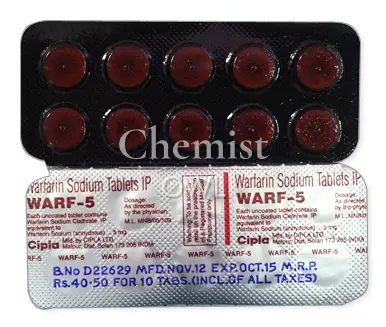
Coumadin is an oral anticoagulant of the vitamin K antagonist class (agents that block the action of vitamin K). Its primary therapeutic purpose is to prevent the formation of abnormal blood clots that can travel through the bloodstream and cause harm.
In pharmacological terms, warfarin is the active ingredient commonly used under the brand name Coumadin. It belongs to the vitamin K antagonist (VKA) family and acts by reducing the liver’s production of clotting factors that require vitamin K for activation.
The medication is prescribed to lower the risk of clot-related events in individuals with certain heart or vein conditions, and to manage ongoing risks after thrombotic events. In the United Kingdom, treatment decisions are guided by assessments of clot risk and regular INR testing to monitor anticoagulation levels.
Warfarin therapy requires ongoing monitoring and adjustment, typically under a clinician’s supervision, to achieve a balance between preventing clots and avoiding excessive bleeding. The aim is to maintain the blood’s tendency to clot within a defined range appropriate for the indication.
Warfarin is prescribed for several clinically supported indications where the risk of clot formation outweighs potential bleeding risks. The following represent common, guideline-supported uses.
Prevention of stroke and systemic embolism in patients with nonvalvular atrial fibrillation, where irregular heart rhythm increases the likelihood of clots forming and travelling to the brain.
Treatment of acute venous thromboembolism, including deep vein thrombosis (DVT) and pulmonary embolism (PE), and prevention of recurrence after initial events.
Prevention of thromboembolism in patients with mechanical heart valves or high-risk valve disease, where prosthetic or altered valve function elevates clot risk. Therapy is individualized based on valve type and patient factors.
Postoperative thromboembolism prophylaxis in selected surgical contexts or medical conditions when risk assessment indicates a high probability of clot formation. Treatment plans are coordinated between the prescriber and the patient’s care team.
Simple explanation: Warfarin blocks the action of vitamin K, which is required for the production of several clotting proteins. By limiting these proteins, the blood’s tendency to form clots is reduced.
Detailed pharmacology: Warfarin inhibits the enzyme vitamin K epoxide reductase (VKOR), thereby interrupting the recycling of inactive vitamin K. This reduces gamma-carboxylation of clotting factors II (prothrombin), VII, IX, and X, and of the anticoagulant proteins C and S, diminishing their functional activity. The net effect is a slower, less efficient coagulation cascade, which translates to a reduced risk of clot propagation and embolism.
Pharmacokinetics and dynamics: The onset of action is not immediate because existing clotting factors must be depleted before full effect is observed. The peak effect is typically reached after several days, and the duration of action persists as long as warfarin exposure continues. Variability in metabolism, hepatic function, and concurrent medications influences the overall response and requires individualized dosing.
Additional pharmacology notes: Warfarin is metabolised in the liver primarily by cytochrome P450 enzymes, with genetic variations and interactions affecting its activity. The two enantiomers of warfarin (S-warfarin and R-warfarin) have different potencies and metabolic pathways, which can contribute to variability between patients. Diet, liver health, and other drugs can shift how strongly warfarin acts at any given time.
Warfarin dosing is individualized and adjusted based on regular laboratory measurement of the international normalised ratio (INR). The aim is to keep the INR within a target range appropriate to the condition being treated or prevented.
In the United Kingdom, patients typically begin with a cautious dose and then undergo frequent INR checks to adjust dosing until stability is achieved. Once stable, monitoring intervals usually lengthen, with continued review by the prescriber or anticoagulation clinic.
INR targets commonly fall around 2.0–3.0 for many indications, though certain situations may require a higher or lower range. For mechanical heart valves or other high-risk scenarios, the target range may differ and will be specified by the clinician.
Practical administration: Warfarin is usually taken by mouth once daily, at the same time each day to optimise consistency. Dose changes are made by the clinician, based on INR results and clinical circumstances. Patients should not alter the dose without professional guidance.
Missed doses, missed days, or periods of illness can affect anticoagulation. If a dose is forgotten, consult the prescriber for guidance before taking a double dose to catch up. Maintenance of a consistent routine and timely INR testing are essential for safe therapy.
Monitoring and follow-up: Regular INR testing is essential to ensure the dose provides adequate anticoagulation without excessive bleeding risk. The frequency of testing is determined by stability, time on therapy, and changes in health or new medications. A patient information leaflet accompanying the medication should be consulted for specific guidance.
Warfarin may be unsuitable for some individuals. Contraindications include known active major bleeding, certain bleeding disorders, and significant liver disease, among other conditions. A clinician will assess individual risk prior to starting therapy.
Common adverse effects relate to bleeding and bruising. Minor bleeding such as nasal bleeding, gum bleeding, or easy bruising may occur more readily while taking warfarin. More serious bleeding can occur in the gut, brain, or other sites and requires urgent medical attention.
Pregnancy considerations: Warfarin is teratogenic and may harm a developing fetus. It is generally avoided in pregnancy unless a clinician determines that benefits outweigh risks. Alternative anticoagulation options may be discussed in planning pregnancy or if pregnancy occurs while on therapy.
Special cautions: Bleeding risk is increased with age, the use of other anticoagulants or antiplatelet medicines, alcohol excess, or liver dysfunction. The patient should inform all healthcare providers about current warfarin therapy, including during dental work or surgical procedures, so appropriate management can be arranged.
Dietary vitamin K intake influences warfarin’s effect. A consistent dietary pattern regarding vitamin K-rich foods (such as leafy greens) is advised to avoid significant fluctuations in anticoagulation levels. Major changes in diet may necessitate INR re-evaluation.
Drug interactions are common with warfarin. Some medicines can increase bleeding risk, while others may reduce warfarin efficacy or increase its activity. It is essential to inform all healthcare providers about current therapy and to discuss any new medicines, including over-the-counter products and supplements.
Alcohol: Intake should be discussed with the clinician, as excessive drinking can affect liver function and bleeding risk. Abrupt changes in alcohol consumption may necessitate INR reassessment.
Practical guidance: Pharmacists and clinicians can provide a personalised list of medications to avoid or adjust. A current medication list should be kept accessible, and any new medicines should be reported promptly for safety review.
When selecting a vitamin K antagonist, clinicians consider factors such as pharmacokinetics, monitoring requirements, and indications. The following comparison highlights general differences among common VKAs used in the United Kingdom.
| Drug | Mechanism | Indications | Notes |
|---|---|---|---|
| Warfarin (Coumadin) | Inhibits VKOR; reduces synthesis of clotting factors II, VII, IX, X | Wide range of indications including AF, DVT/PE, mechanical valves | Requires regular INR monitoring; pharmacokinetic variability is common |
| Phenprocoumon | Vitamin K antagonist; similar mechanism to warfarin | Approved for long-term anticoagulation in many European countries | Longer half-life may affect dosing adjustments |
| Acenocoumarol | Vitamin K antagonist; acts via VKOR inhibition | Anticoagulation for various thromboembolic risks | Shorter half-life; dosing can change more quickly with INR |
Perioperative management requires coordination between the patient, pharmacist, and surgical team. The goal is to minimise bleeding risk while protecting against thromboembolism. INR assessment and timing of warfarin interruption are tailored to the procedure and patient risk profile.
Bridge therapies (temporary substitution with alternative agents) may be considered in high-risk situations, depending on the planned procedure, bleeding risk, and the patient’s thrombosis history. The decision rests with the treating clinician and is often based on guideline recommendations and local practice patterns.
Before any surgical or dental procedure, the patient should inform the provider about current warfarin therapy. Specific instructions regarding stopping or continuing warfarin, timing of INR testing, and whether bridging is required will be provided as part of a personalised plan.
If bleeding occurs during or after a procedure, seek urgent medical help and follow the guidance provided by the healthcare team regarding stopping or resuming anticoagulation therapy and any necessary investigations or reversals.
Off-label use refers to using a medication for a condition or in a manner not specifically approved by regulatory authorities. Warfarin is sometimes considered off-label in certain clinical scenarios, and such use should occur within a formal medical plan and with informed consent.
Examples of commonly discussed off-label considerations include extended thromboembolism prevention in selected high-risk surgical populations and certain coagulation disorders where risk assessment suggests benefit. Decisions are made on a case-by-case basis and rely on clinician judgment and available evidence.
Any off-label consideration must be discussed with a clinician, with an emphasis on balancing the risks of bleeding against the potential benefit of reduced clot formation. Prior to any off-label use, the official patient information leaflet should be consulted, and professional guidance obtained if there is uncertainty.
For any off-label discussion, check the official patient leaflets and seek professional guidance to confirm suitability, monitoring needs, and safety considerations. The information provided here is not a substitute for tailored medical advice.
Long-term anticoagulation requires periodic reassessment to confirm ongoing need, assess risk factors, and monitor for adverse effects. The duration of therapy is determined by the underlying condition, recurrence risk, and the patient’s evolving health status.
Regular follow-up appointments should be scheduled to review anticoagulation goals, review the medication list for potential interactions, and ensure that INR levels remain within the target range. Changes in health, weight, liver function, or new medications can affect dosing needs.
Stopping warfarin should only occur under medical guidance. In some cases, a transition to another anticoagulant or a plan to discontinue treatment may be appropriate, depending on the condition being treated and patient risk profile. Any planned cessation requires a clear plan for monitoring and safety.
Patients should be advised to maintain a current list of medications and to inform all future healthcare providers of warfarin therapy. Education about signs of bleeding and when to seek care is an essential component of ongoing management.
The information below addresses common questions about therapy with warfarin. When in doubt, consult a pharmacist or clinician for personalised advice based on individual risk factors and clinical history.
INR testing and what it measures are central to therapy; this test guides dosing decisions to maintain balance between preventing clots and avoiding excessive bleeding.
Emergency situations involving bleeding require immediate medical attention. If severe bleeding occurs, seek urgent medical help promptly and follow professional instructions for hospital care and potential reversal strategies.
Coordination with the dental professional and the anticoagulation team is essential. In many cases, warfarin therapy continues with careful monitoring, but some procedures carry higher bleeding risk and may warrant temporary adjustment. A clinician will provide specific instructions based on the procedure and coagulation status.
If a dose is missed, contact the prescriber for guidance before taking additional measures. Do not double the dose without professional advice. The priority is to maintain stable anticoagulation rather than chasing a missed dose.
Warfarin does not produce immediate anticoagulation. The effect develops over several days as existing clotting factors decline. The full therapeutic effect is typically observed after the initial days of therapy and is verified by INR monitoring.
Consistent intake of vitamin K–rich foods is advised to prevent large fluctuations in anticoagulation. Abrupt, major changes in vitamin K consumption can alter warfarin’s effectiveness. A dietitian or pharmacist can help tailor dietary guidance to individual needs.
Numerous medicines can interact with warfarin, potentially increasing bleeding risk or decreasing effectiveness. Always inform healthcare providers about current medications, including over-the-counter products and supplements, before starting any new therapy. A clinician can assess interactions and adjust treatment as needed.
Any unexpected or prolonged bleeding should be evaluated promptly by a healthcare professional. Seek urgent medical help if there is heavy bleeding, blood in urine or stools, vomiting blood, or if there is fainting, severe headache, or dizziness.
Long-term use can be safe when carefully managed with regular INR monitoring, dose adjustments, and ongoing risk assessment. The decision to continue therapy depends on balancing the risk of thrombosis against bleeding risk and is reviewed at routine follow-up visits.
Warfarin carries risks during pregnancy and is generally avoided unless a clinician determines that benefits outweigh risks. If pregnancy is planned or occurs, urgent consultation with a clinician is necessary to discuss alternatives and monitoring requirements.
Initial dosing is guided by clinical factors and may require adjustments based on INR results. Dose changes are made by an authorized clinician and communicated to the patient. Self-adjustment is not advised without professional guidance.
Any new prescription, over-the-counter medication, or supplement can affect warfarin’s action. A healthcare professional should review all changes to determine whether adjustments are needed and to plan monitoring schedules accordingly.
The duration depends on the underlying condition and ongoing thromboembolic risk. Some patients require long-term therapy, while others may transition to alternative anticoagulants or discontinue therapy after a specified period, as advised by the clinician.
14–21 days. Free from £151.46 .
5–9 days. £22.72
−10% when paying with cryptocurrency.
−10% on all repeat orders.
All orders are packed in neutral, unbranded boxes with no product name on the outside.